Character TD (Freelance)
2012
SPA - Troglodita
Troglodita: A Character Built to Perform Like a Drawing
TLDR: Solo freelance engagement for The SPA Studios in 2012, done from my home studio in Granada. Sergio Pablos, who animated at Disney during the studio's peak and would later direct Klaus, needed a 3D character that could move with 2D fluidity for an internal short film. Full pipeline, one artist: modeling rebuilt against budget to raise the deformation ceiling, a layered facial system with sliding controls travelling over NURBS surfaces emulating the skull, a coordinate-based corrective trigger system, a batch pipeline for 130+ shapes, body rig, and animation tools. Fully procedural, regenerable from code, written from scratch in Python. 893 reactions and 13.2K views on ArtStation, a Rigging Dojo feature interview, and selection as the ArtStation thumbnail for the Character TD category. The work that came out of that job, a procedural systems-thinking approach to building characters, is the same working method that later traveled into Disney's biped topology work and Meta's parametric architecture.
DETAILS
Studio: The SPA Studios
Project: Troglodita (internal short film)
Role: Character Artist & TD (Freelance)
Tools: Maya, Python, ZBrush
Year: 2012
Partners: Sergio Pablos (director), The SPA Studios animation team
Shipped: Rebuilt character model (against budget, for deformation range), layered facial rig (sliding NURBS controls, region interdependence, precision joint layer, coordinate-based correctives), batch shape pipeline for 130+ blendshapes, body rig with body hair deformation layer, animation tools for the team (visibility levels, mirror and flip), fully procedural Python autorig regenerable from code.
Results: 893 reactions, 13.2K views on ArtStation. Rigging Dojo feature interview. Selected as the ArtStation thumbnail for the Character TD category. Consulting sessions teaching the system to other studios.
Links: ArtStation reel
THE CONTEXT
Solo freelance job, done from my home studio in Granada. The SPA Studios was reviving an internal short film that had been on hold. The character, a caveman called Troglodita, needed to be rebuilt from scratch in Maya (the previous version was in 3ds Max) and rigged to perform with the expressiveness of hand-drawn animation.
At most studios, this scope would have been split across a team: a modeler, a rigger, a TD, a tools developer. I was one person. There were no tutorials for a system like this, no off-the-shelf solutions, and no senior rigger down the hall to unblock me when a system decision was load-bearing. Every layer of the craft led to the next technical problem, and I wanted to solve all of them.
THE CHALLENGES
Sergio Pablos animated at Disney during the studio's peak: supervising animator on Tarzan and Treasure Planet, character designer on A Goofy Movie. He created the concept that became Despicable Me. He would later direct Klaus. Hiring me solo, for the full pipeline on a character he would direct personally, was the kind of trust I do not forget.
When an animator like Pablos works in 3D, he does not accept what the medium typically offers. He wants the same malleability as 2D: squash and stretch pushed to extremes, art-directed silhouettes on every frame, control over every deformation. A standard rig would constrain him to what the technology allows. The character needed to feel as fluid as a pencil in his hand.
That expectation set the bar for every other decision. The model had to have enough room to deform. The rig had to give the animator per-frame art direction without fighting the rig. The facial system had to respond to the performance instead of imposing a deformation grammar on top of it. One person had to build all of it, and all of it had to hold up under a Disney-trained animator's eye.
THE APPROACH
Full pipeline, solo: modeling, UVs, body rig, facial rig, animation tools. Everything in Python, procedural, regenerable from scratch. Every decision driven by one question, which I kept asking through every layer of the build: what does this give the animator?
Rebuilding the model
Pablos provided the design and an existing model. I rebuilt it from scratch, against the agreed budget. The existing mesh lacked appeal at rest and did not have the resolution to support the nuances and the deformation range Pablos would demand. No rig can overcome a model that does not have room to deform, and the safer choice (working within the existing mesh's limitations) would have capped the ceiling for everything downstream.
I did not redesign the character. I rebuilt it with the full deformation range in mind. Every edge loop placement was a decision about what the character could do when animated: how the muzzle stretches, how the brows compress, how far the cheeks push before the mesh breaks. This was a creative judgment call, not a technical one, and it was the first structural bet of the project. It raised the ceiling for everything that followed.
Facial rig: controls that follow the face
The facial rig was the core challenge. When a 2D animator moves a cheek, it follows the skull's curvature naturally. In 3D, that spatial awareness does not exist unless you build it.
I built a multi-layered deformation system:
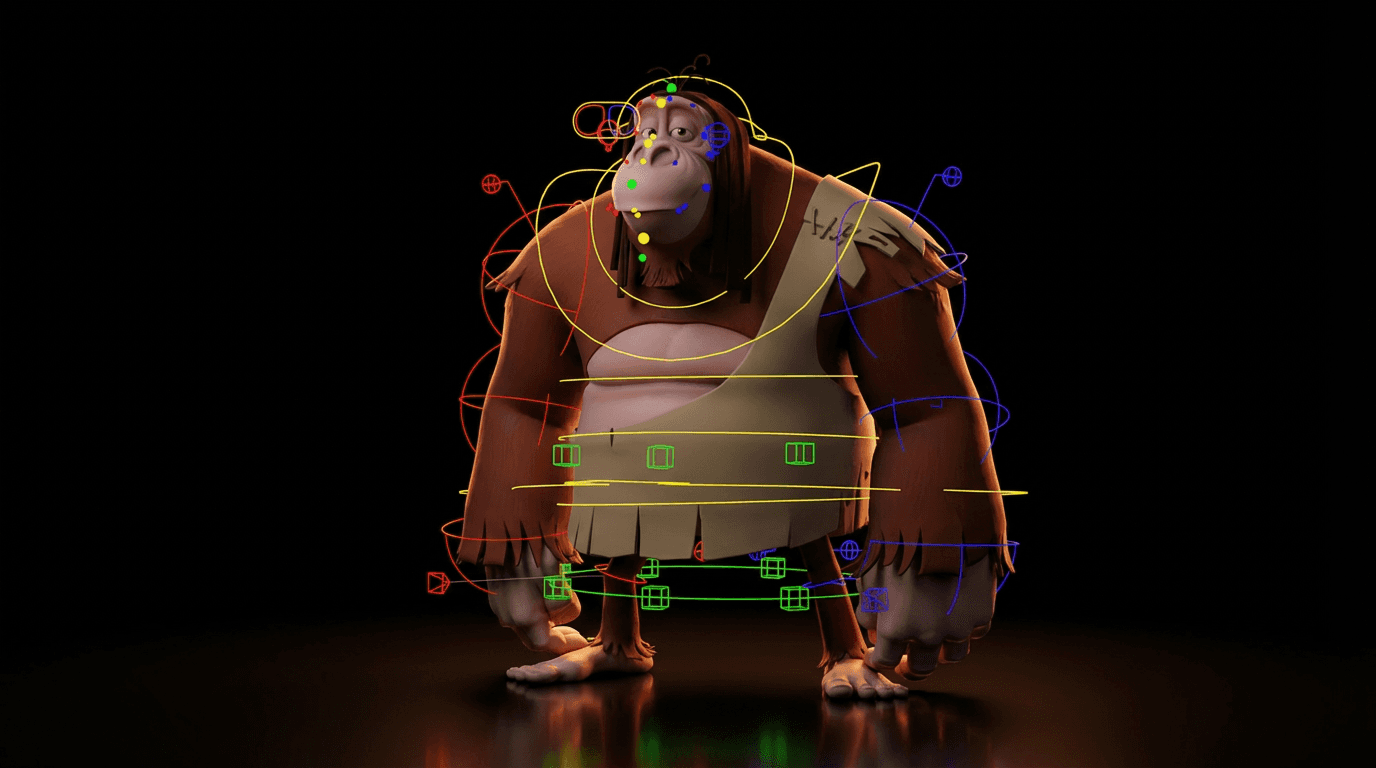
Sliding controls on NURBS surfaces. The main facial controls travel over surfaces that emulate the character's skull shape. A single-axis translation describes a non-uniform arc following the precise muzzle shape at that position. The controls know where they are on the face at all times. A standard joint-based facial rig would have been faster to build, but it could not produce the spatial awareness Pablos needed. The architectural idea of using an intermediate surface layer for spatial relationships is similar to approaches that other major studios have also adopted.
Region interdependence. The sliding controls define a network of curves and surfaces, creating a dependency system where moving the cheek influences the nose bridge the way a real face does. Connected, not isolated. The face behaves like a face, not like a collection of independent sliders.
Precision layer. Joints handle the fine-tuning: subtle brow rotations, scaled-up eye for emphasis, the per-frame art direction Pablos expected. The sliding layer does the anatomy. The joint layer does the acting.
Correctives from the performance. The combined deformation state becomes the canvas for sculpting corrective shapes. Extreme poses get refined without rebuilding the system. Because every control knows its UV coordinates on the NURBS surface, the rig automatically activates the right corrective shapes at the right intensity. The animator pushes the face to an extreme. The system responds. The animator focuses on the performance.
130+ shapes, one artist
The corrective library grew fast, and at solo scale it would have buried me without a batch pipeline to carry the mechanical work. I wrote one: mirroring, splitting (brows inner/middle/outer, mouth inner/middle/outer), naming, exporting, multiple blending modes. Export raw meshes for sculpting, connect them back, update when needed. Fast iteration without manual rework.
The shape library is the part of the system that would traditionally eat a character TD's month. The batch pipeline compressed that cost into something a single person could run and re-run as the character evolved.
Body rig and animation tools
Standard biped autorig with an extra layer for body hair deformations. Modular Python stages I could re-run independently when the model changed. Animation tools for the team: geometry and control visibility levels, mirror and flip for poses. Small quality-of-life features that made the rig nicer to live inside for the animator holding it.
Only one third-party script was used across the whole build (Chad Vernon's delta extraction tool). Everything else was written from scratch, all Python, all mine to rebuild if the project shifted. This was 2012. No ChatGPT, no Claude, no Copilot, no autocomplete worth the name. You read the Maya API docs, you asked on the forums, and you wrote what you needed line by line.
The workflow that stayed
The Troglodita job was the first time I built a full character pipeline end to end, under a bar set by someone who had carried characters at Disney's peak. The specific rig shipped. The short film stayed internal. The thing that actually outlasted both of them is the working method.
A procedural, systems-first approach to characters. Build the model for the deformation range the animator will demand. Build the rig as code that can be rerun when the model updates. Push the spatial intelligence into the system itself (sliding controls that know where they are, correctives that trigger from coordinates) instead of asking the animator to hold it in their head. Treat the shape library as a batch problem, not a per-shape one. Write the pipeline so any layer can be regenerated independently.
Shipping, and what it actually meant
What shipped was a character that could perform like a drawing. A rebuilt model with the appeal and mesh resolution to carry extreme deformation. A layered facial system where controls travel over NURBS surfaces emulating the skull, and where the combined deformation state activates the right corrective shapes automatically based on coordinate position. A batch pipeline for 130+ shapes that compressed the mechanical cost of splitting and connecting the shape library. A body rig with a body hair deformation layer. Animation tools for the team. A fully procedural Python autorig, regenerable from scratch, written almost entirely from first principles.
The work found its audience without a studio brand behind it. A feature interview with Rigging Dojo. Consulting sessions teaching the system to other studios. ArtStation chose this rig as the thumbnail for their Character TD category, which is the kind of peer signal that still means quite a lot to me.