Character Artist (Freelance)
2018-2020
Riot Games - League of Legends Collectibles
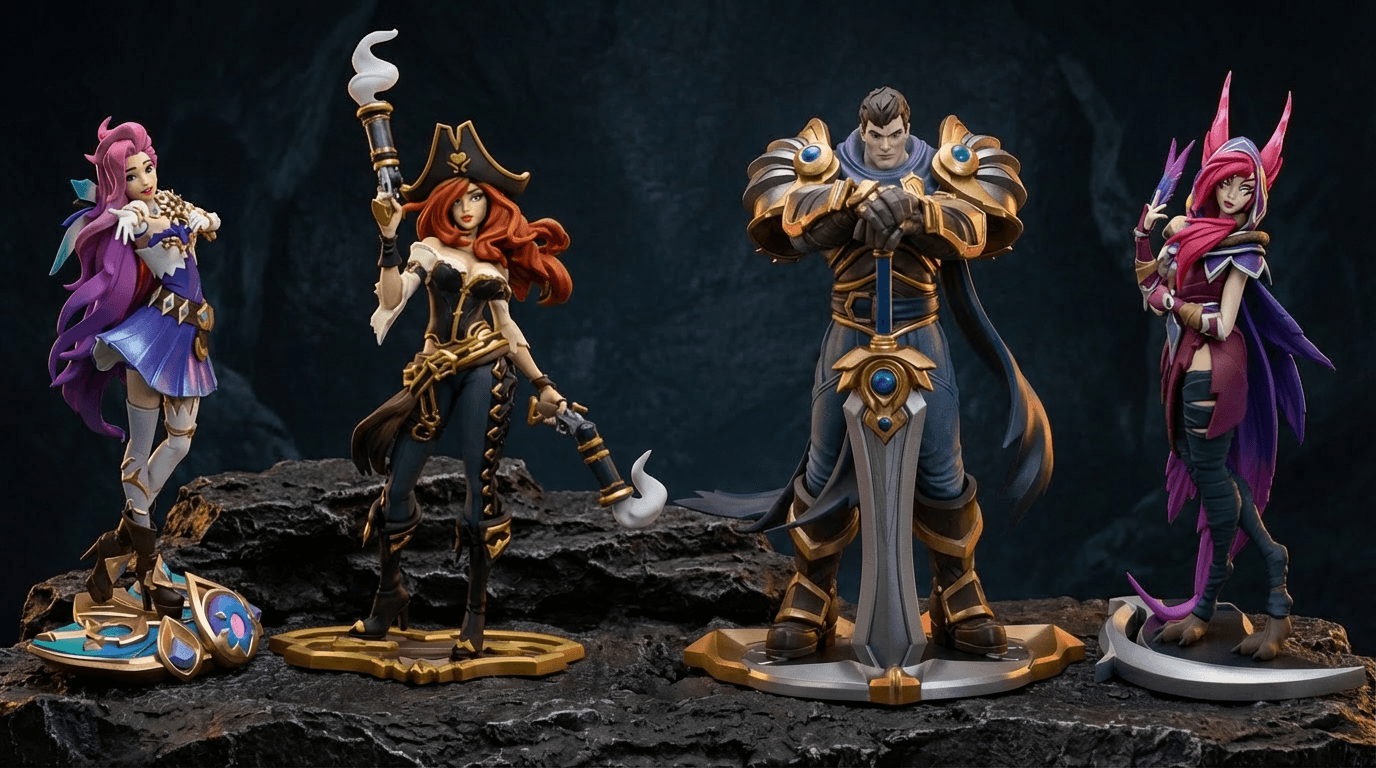
Riot Games: League of Legends Collectible Sculptures
TLDR: Three years freelancing for Riot Games between 2018 and 2020, thirteen collectible figures across the League of Legends Unlocked collection and a separate chibi line. Irene Matar brought me in on the project, and her own deep background in collectibles carried the manufacturing constraints into the brief and recommended the creasing workflow as the way through them. First time in a long career sculpting characters that did not have to deform, which freed topology to be a design tool for the first time. Built simple Maya rigs for each figure to land the iconic pose cleanly, twenty years of TD knowledge applied at the lowest fidelity it ever needed to operate at. The workflow held cleanly on a single model and broke under volume: crease data lost between Maya and ZBrush, symmetry collapsing on posed figures, subdivision behavior diverging between tools. Re-creasing the same edges three or four times a session became the dominant time cost. The repetition was the signal. I built a script to stop repeating myself, and that script became CreaseManager, the first MeshSynergy tool. The workflow it unlocked, paired with a reconstructable low-res base topology, became my default on every character project since, personal and professional, and started leaking into my Disney pipeline during Encanto.
DETAILS
Studio: Riot Games
Project: League of Legends Collectibles (Unlocked collection + chibi line)
Role: Character Artist / Freelance Sculptor
Tools: Maya, ZBrush
Year: 2018-2020
Partners: Irene Matar (brought me in on the project, deep collectibles background, source of the creasing recommendation and the manufacturing constraints), Riot Games art direction, Riot's collectibles manufacturing team
Shipped: 13 collectible PVC figures across two League of Legends product lines, simple Maya rigs for posing each figure, plus the production-friction insight that became CreaseManager (released MeshSynergy tool) and seeded ModelToPose. Established the working method (crease workflow + reconstructable low-res base topology) that has been my default character pipeline ever since, on personal and professional work, and that I began sharing with the Disney character team during Encanto.
Links: [Riot Games Merch]
THE CONTEXT
Riot Games was expanding the League of Legends franchise into physical collectibles, and Irene Matar brought me in as a freelance sculptor to deliver thirteen character figures across two product lines: the Unlocked collection (full-scale sculptures with signature weapons and armor) and a separate chibi line (stylized, compact champion variants). Irene had her own deep background in collectibles, and her experience shaped the brief from the inside. She was the one who carried the manufacturing constraints into the project, and the one who recommended the creasing workflow as the way through them. Across both product lines, my role was the same. Sculpt the champions in their final pose, prep the geometry for PVC manufacturing, and hand the files off to Riot's collectibles team.
This was my first collectibles project, and it came with a freedom I had not had in over a decade of character work. Collectibles do not deform. No rigging, no animation, no bone influence to plan loops around. Edge flow could serve the form, not the rig. Topology became a design tool for the first time, instead of a constraint I was negotiating with on every loop decision.
THE CHALLENGES
PVC injection molding compresses and rounds edges as the plastic cools in the mold. A clean bevel in the digital file becomes a soft, undefined edge in the final piece on the shelf. For League of Legends champions, where the design language depends on detailed costumes, signature weapons, sharp armor silhouettes, that softening means lost identity at retail. Riot needed geometry that was intentionally over-sharpened on screen to compensate for what molding takes away in the physical world.
Irene Matar recommended creasing as the solution. She had used the workflow on previous collectibles work, and she knew exactly what the molding team would and would not accept on the manufacturing side. Crease weights in Maya, smooth viewport preview for art review, sharp export for manufacturing. One file, two states, with the same asset serving both the approval pipeline and the molding pipeline. On a single model, the workflow was elegant. The problem was not the workflow itself. The problem was that the workflow had been designed around a single model, and I was working on thirteen.
THE APPROACH
Topology as a design tool, for the first time
The shift from rigging-aware to rigging-free topology sounds small from the outside. It is not. Almost every sculpting decision I had made over a decade of character work had been quietly negotiated against a rig that would inherit the mesh: edge loops around joints, predictable flow for bone influence, density distributed for deformation rather than for the eye. On a collectible, none of that load is on the topology.
That meant I could let the loops follow the silhouette, the costume seams, the weapon geometry, the points where light would catch the molded plastic. Density where the surface needed to hold detail through molding compression, looseness where it didn't. Edge flow that served the read of the figure on a shelf rather than the rotation of a joint in an animation. The first few models, I kept catching myself defaulting to deformation-aware patterns that the project did not need. By the third or fourth, the new pattern stuck.
Rigging for pose, not for animation
Collectibles do not deform, but they do still need to land in a pose. The Unlocked figures live or die on the iconic stance: the weapon raised, the cape mid-flare, the spell-cast moment frozen with the silhouette readable from across a shelf. The chibi line is the same problem at smaller proportions, more compression, and even less margin. Sculpting the pose by hand on the neutral mesh is technically possible, but it is slow, it is destructive, and it leaves no room to iterate when art direction asks for the same character but with a different pose.
So I built simple rigs in Maya for every figure. Not production rigs in the Disney or Meta sense, with full deformation systems, secondary controls, FACS, blendshape libraries, the whole apparatus. Light rigs. Skeleton, skin, a small set of controllers for the body and the weapon, just enough scaffolding to pose the character cleanly, push the silhouette, iterate against direction notes, and lock the pose down for the manufacturing handoff.
It is the kind of move I have never minded making. Heavy tool for a light purpose, when the light purpose actually benefits from the heavy tool's structural clarity. Faster than sculpting a pose. More forgiving than sculpting a pose. More respectful of the next round of feedback than sculpting a pose. The figures shipped in iconic stances because the pose was treated as a proper rig problem, even though no one outside my own files would ever know there had been a rig.
Building against the molding tax
The creasing workflow Irene recommended was the right answer to the right problem, and the kind of recommendation that only comes from someone who has lived through several rounds of manufacturing on the receiving end. PVC softens edges during cooling, so the digital model has to over-sharpen to compensate. Creases let me carry both states in a single file: smooth in the viewport for art review, sharp in the export for the mold. In Maya, this lived in the crease editor. Mark the edges that needed to stay sharp, set the weight, leave the rest to subdivision. In ZBrush, the same principle resolved differently against the topology density of the sculpt.
For the first model, the workflow was clean end to end. Sculpt, crease, preview, export, review, ship. The discipline was easy to hold inside one file. What I underestimated was how much of that discipline lived in my hands and not in the file itself.
Where the workflow broke under volume
Across thirteen figures, with revision cycles on most of them, three friction points compounded:
Crease data lost between tools. Moving a model from Maya to ZBrush and back stripped crease information. OBJ and FBX did not reliably preserve the metadata, and every round-trip meant re-creasing the same edges by hand on the receiving side. On a single model, this is annoying. On thirteen, with sculpts moving back and forth as the silhouette evolved, it became the dominant cost of the workflow.
Symmetry collapsing on posed models. Collectibles ship in dynamic poses, not in T-pose. Once posed, the symmetry that had carried crease values across mirrored limbs in the neutral mesh stopped working as expected. Maintaining symmetrical crease values across a mirrored arm or leg required per-edge manual adjustment, and posed geometry made the mirror axis itself harder to operate against.
Subdivision behavior diverging between tools. Maya and ZBrush use different crease models. A crease weight of 0.8 in Maya did not produce the same result in ZBrush. There is no direct mapping. Each tool had to be treated independently, with me holding the intent in my head and translating it across context switches. Across thirteen figures, that mental load was real.
None of these were showstoppers on a single model. On thirteen models with revision cycles, I was re-creasing the same edges three or four times per session, holding the equivalence map between two tools in my head, and absorbing a per-edit tax that scaled with how often a sculpt moved between contexts. That tax became the dominant time cost on the project.
Reading the repetition as signal
There is a thing I have learned to pay attention to over the years, and it landed hard on this project. When I find myself doing the same manual sequence more than a couple of times in a row, especially when I can see exactly why it keeps breaking, that is not just an annoyance. It is a gap in the toolset. And if I am hitting it on thirteen models, every character artist working a comparable pipeline is hitting it too.
So I built a script. Not to sell, not for a product roadmap, not because I had a market in mind. To stop repeating myself. The script handled crease creation, editing, mirroring, and flipping across multiple meshes inside Maya, and gave me a path to round-trip crease data without losing it on every export. It was small at first, and it grew alongside the project. By the time the Riot collectibles work was wrapping, the script had moved from "thing I wrote to stop repeating myself" to "thing I open every single time I touch a Maya scene." That shift is the one I have learned to watch for. When something I built to unblock myself becomes part of how I work by default, it is usually worth showing to other people.
That tool became CreaseManager, the first released MeshSynergy tool. It is still my daily driver, and is one of the longest-shipping products on Gumroad in the studio toolkit. The posing-and-symmetry friction from the same project seeded a separate line of thinking that eventually became ModelToPose, a tool for generating a rig on a posed character without having to neutralize it first. The architecture for ModelToPose is still in development, but the seed came from the same thirteen figures.
The workflow that stayed
The interesting thing about CreaseManager, looking back, is not that it became a product. It is that the working method it unlocked became the method I have used on every character project since, personal or professional, for years. The combination is what matters: a crease-driven approach to edge sharpness, paired with a properly reconstructable low-resolution base topology that you can always return to, edit cleanly, and rebuild the high-fidelity mesh from. Crease without reconstructable topology gives you sharp edges on a frozen sculpt with no path back to the cage. Reconstructable topology without crease gives you a clean cage with no path to controlled hardness in the export. Together, they give you something that has held up across the thirteen Riot figures, every personal piece I have built since, and the Disney work that followed.
It started leaking into my professional pipeline on Encanto. By that point, the Riot work was behind me, the workflow had been operational on my home machine for over a year, and the combination of crease-based edge control plus the low-res reconstructable base mesh had become my default for any character. I started showing it to my Disney character team during production: how the crease workflow took the edge-control problem off the modeler's hands without sacrificing the smoothness of the proxy mesh, and how building on top of a properly reconstructable base meant the team could iterate on the geometry without losing the work that had already been put into it. Some of it stuck immediately, some of it took longer to land in a studio context where the existing modeling discipline was already deeply rigorous and not easily redirected. But the conversation had started, and the workflow that began on a Riot collectibles project began to travel beyond my own files.
That is the part of this case study that surprises me most when I look back. The thirteen figures are the work I was hired to deliver. The tool is what I built so I could deliver them. The working method that the tool unlocked is the thing that has actually outlasted everything else, that became the default I now apply on every character project, and that started showing up in modeling workflows in a major Disney feature a few years after the project that birthed it had wrapped.
Shipping, and what it actually meant
Thirteen collectible PVC figures shipped across two League of Legends product lines: the full-scale Unlocked collection with signature weapons and armor, and the smaller chibi line of stylized champion variants.
What also shipped, alongside the figures, was a workflow tool that has outlasted the project itself. CreaseManager is now in use by character artists working similar Maya/ZBrush pipelines, and it is the proof that production friction, paid attention to, becomes infrastructure. Every MeshSynergy tool I have built since has come from the same pattern. Real constraint, real workflow, real repetition, real script to stop the repetition, and only then a question about whether someone else might want to use it.
Irene Matar brought me onto the project, carried the manufacturing constraints into the brief from her own deep collectibles experience, and recommended the creasing workflow that became the seed for everything downstream. Without Irene there is no Riot project for me. Without the manufacturing constraint she carried in, there is no creasing workflow. Without the creasing workflow there is no friction at volume. Without the friction at volume there is no CreaseManager. The tool exists because the partnership existed. Riot Games' art direction set the bar for the figures themselves and gave me the brief I built against. Riot's collectibles manufacturing team carried the work the rest of the way into the physical world.
The thirteen figures are the visible part of this work. The tool that came out of building them is the part that has kept paying back for years.